
All Exhibitions here

Luca Ceccherini - Grammelot

 
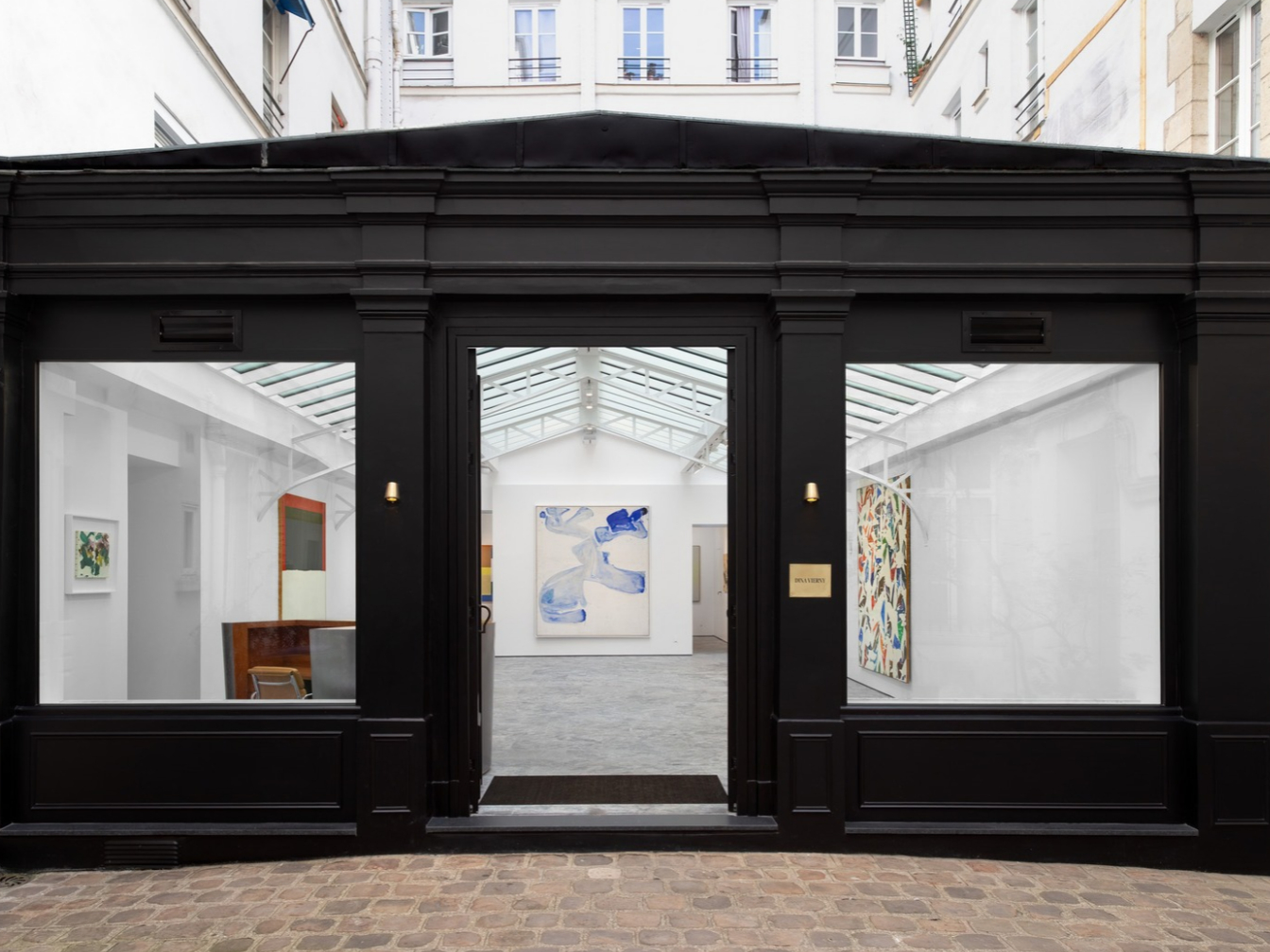
 Galerie Dina Vierny is delighted to present the first solo exhibition in France by the Italian painter Luca Ceccherini (b. 1993). Titled Grammelot, this summer exhibition, featuring a collection of previously unseen works, will run from June 5 to July 29  at our gallery at 53 Rue de Seine.
27.05.2026
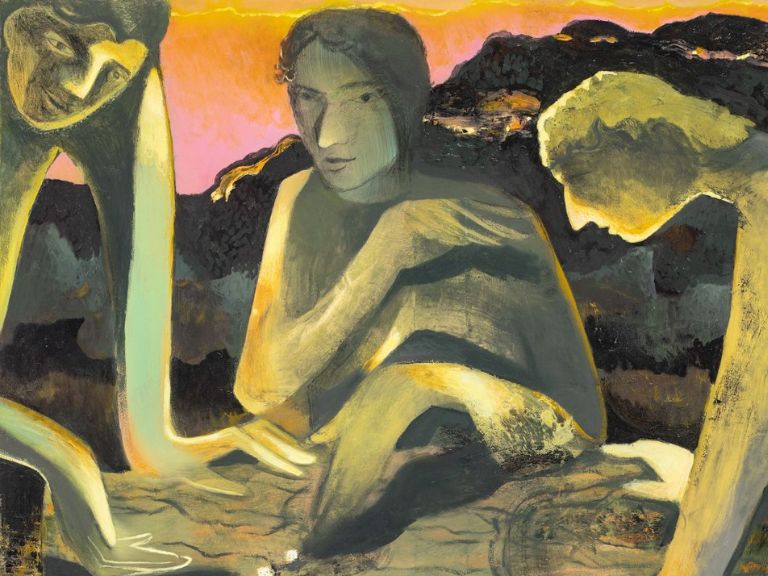
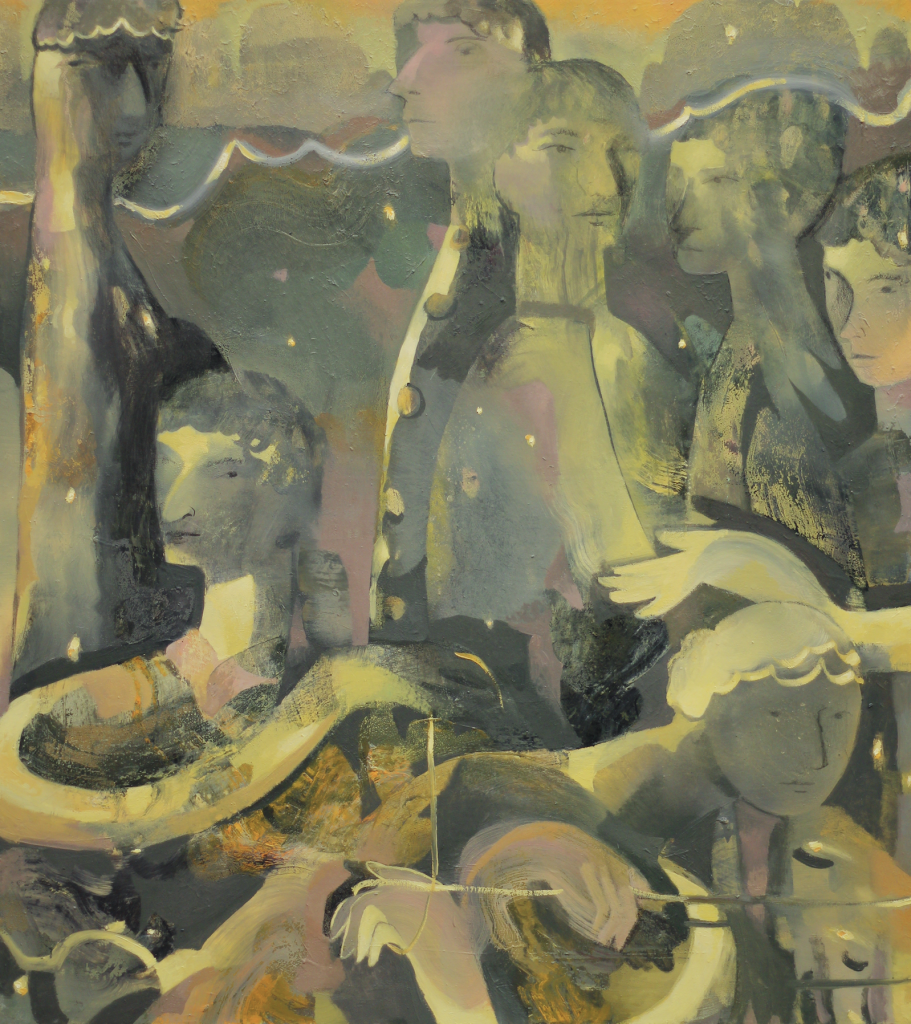
Dina Vierny Luca Ceccherini, Offerta libera, 2026, Techniques mixtes sur toile, 90 x 80 cm
Giorgia Aprosio, 
critique d’art et commissaire d’exposition

There is something paradoxical about writing a critical text on Grammelot, Luca Ceccherini’s first solo exhibition in France at Dina Vierny: a body of work that, in its deepest substance, calls into question the very necessity of the language I am using to write it. 

These very lines are, after all, the offspring of centuries of language, and with it of grammatical rules, academic corrections — of the entire apparatus of bella scrittura and bella lingua that a civilisation constructs in order to say things as they should be said, or rather, as they must be said. 

And yet there exists a way of communicating that precedes all grammar, every academy, every acquired vocabulary. And if it is true that we are not surprised when someone reminds us of this, it is also true that the harder task remains understanding what, really, it consists of. 

Music tries, and sometimes succeeds. So do dance, theatre, and occasionally a certain kind of painting. In Luca Ceccherini’s case, painting does not explain this older form of communication: it makes it happen again.

Ceccherini was born in Arezzo — a biographical fact irrelevant in itself, were it not for the subtle irony that ties him to a land from which some of the founding myths of the Italian language originate: Dante, Petrarch, Boccaccio. But if a certain genealogy of Italian literature begins symbolically here, it is equally true that Arezzo is the city of Pietro Aretino, the most irreverent Italian writer of the sixteenth century, a man who preferred the living nature of the word to linguistic convention.

As though this land had always generated, in equal measure, language and its saboteur.

It is difficult to say whether Ceccherini belongs to the first genealogy or the second. What is certain is only that he was born in the geographical cradle of a particular kind of word — the measured word, the learned word, the written word, and sometimes the painted word. The same word that runs through the limpid geometries of Piero della Francesca, that suspended light and that human proportion which seem to stop time. But Ceccherini then moves to Venice, where, in the Scuola Grande di San Rocco, Tintoretto painted as though the world were collapsing: bodies in torsion, oblique and sharpened light, narratives dense with physical and moral drama that turn silence into noise. He arrives, finally, in Turin, in the refined and melancholic sensibility of a city that has long lived culture as both a shield and a mirror.

Somehow, all of these geographies have acted upon the heart of his painting without it ever coming to belong fully to any of them. The images seen, the atmospheres crossed, the cities lived through become elements grafted onto a landscape which, if we really had to recognise it, would certainly be the Tuscan landscape of origin — but which in Ceccherini is never a view, becoming instead a theatrical backdrop: not a place to contemplate, but the scene upon which, at a certain point, something happens. 

No word yet. 
And yet something has already begun. 

And when it happens, it has a precise structure. 

Vladimir Propp, the Russian folklorist, published his Morphology of the Folktale in 1928, a study demonstrating that beneath the apparent variety of folk narratives lies a limited number of recurring narrative functions, always the same, always in the same order: departure, trial, transgression, punishment, reward. As though the stories humanity tells were an infinite series of variations built upon ancient structures.

Ceccherini works exactly at this level. The stories he tells in painting are never specific, and yet they feel familiar because, deep down, we already know their grammar. He takes iconic elements deposited in the heritage of the collective imagination — the jester, the trickster, the acrobat, the fortune-teller, the fire-eater, the tightrope walker — empties them of their cultural origin, and returns them as containers of meaning. Il carretto dell’indovina (2026), Baruffa (2026), Cattivi consigli (2026), Pessimo attore (2026): each title is a minimal episode, an action and its consequence, something that has always happened among human beings.	
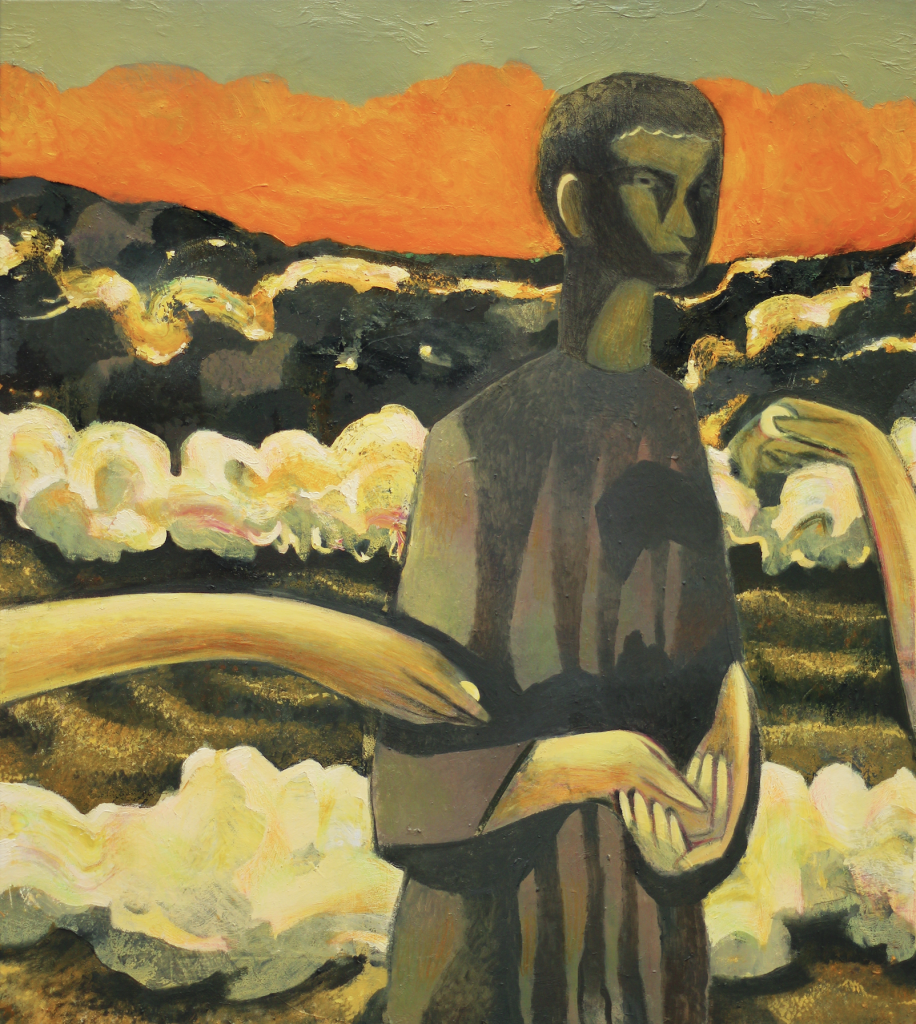

Luca Ceccherini, Offerta libera, 2026, Techniques mixtes sur toile, 90 x 80 cm
 If Propp showed, at the beginning of the twentieth century, that many stories are, deep down, made of the same atoms, revealing how the essence of the folktale lies more in structure than in plot, Dario Fo demonstrated, halfway through the last century, that stories can be told without needing to use even a single “real” word. 

Actor, playwright, painter, cultural agitator, winner of the Nobel Prize in Literature in 1997, Fo created his masterpiece in 1969, Mistero Buffo: a performance in which, alone on stage, he reworked medieval and apocryphal texts, interpreting all the characters involved through an invented language he called grammelot. 

The etymology of the term remains uncertain — and perhaps precisely for that reason, perfect. It probably derives from the French grommeler — to grumble, to mutter — though some have read in it a mixture of grammaire, mêler and argot: grammar, blending, slang. In any case, grammelot is a non-language language, a theatrical mixture of sounds, rhythms, cadences, onomatopoeia, mime and gesture that, in some sense, was born long before Fo, long before that name. 

The players of the commedia dell’arte used it as they passed through the courts of France; the Venetians distorted it into gramlotto; jesters turned it into a comic and satirical instrument: a language capable of mocking power, and at times of eluding it, because it is difficult to censor a text that formally does not exist. A language, in short, that means nothing and precisely for this reason can be made to speak of everything. 

And it is no coincidence that it now gives its name to Ceccherini’s first solo exhibition in France.

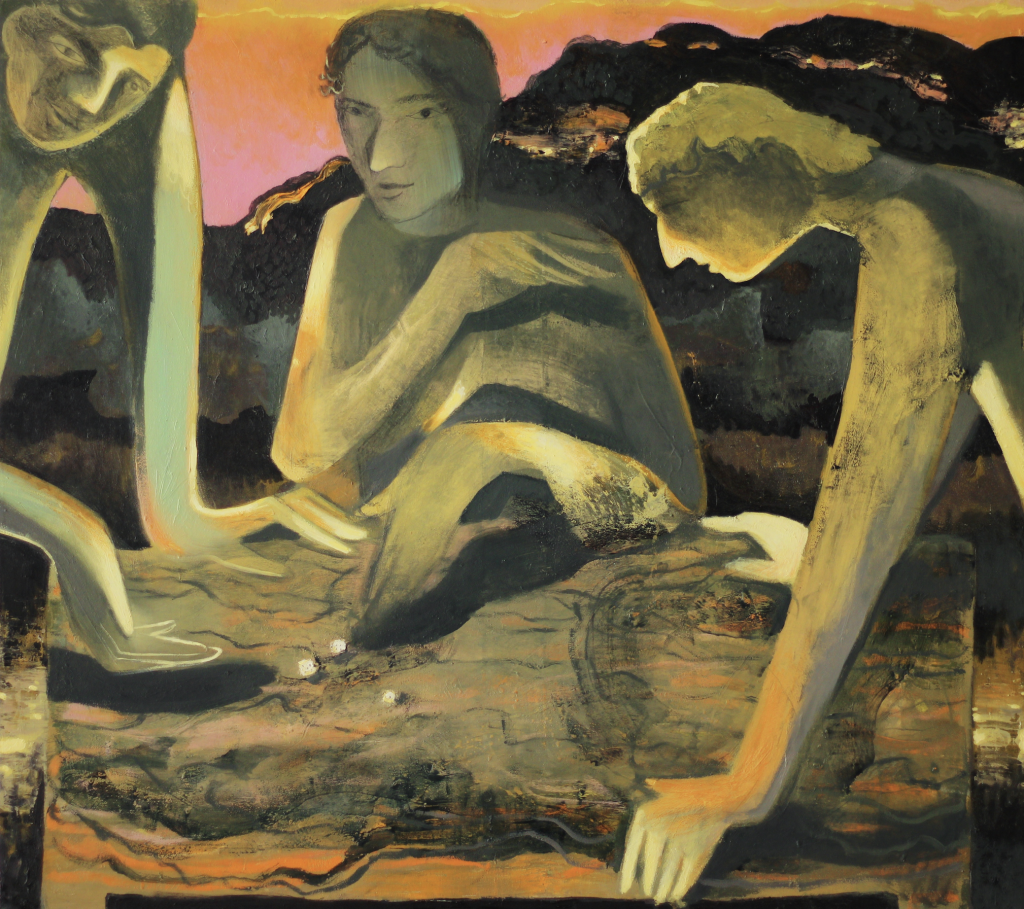
Luca Ceccherini, Astanti, 2026, techniques mixtes sur toile, 90 x 80 cm

 In this exhibition, there is little to understand. The advice, in fact, is to stop trying at once. Better to surrender, as one does before a child and their unknown language, which nonetheless seems, strangely, to be saying something to you. 

Fo wrote as much in Il manuale minimo dell’attore (1987), speaking precisely of grammelot: “It is impossible to lay down rules. One must go by intuition, by an almost subterranean knowledge.” 

But perhaps I have not convinced you yet. 

In the same text, he tells of witnessing a dialogue between a Neapolitan boy and an English boy who, having no language in common, invented one of their own. The Neapolitan pretended to speak English; the English boy pretended to speak southern Italian. They understood each other perfectly. Through varied cadences, gestures and babbling, they had built a code.

The hundreds of stories they had absorbed — fairy tales, cartoons, comedies, comics — had prepared them for that moment: to read an entirely new situation, even without intelligible words. Nothing to do with Esperanto, the artificial language pursued so stubbornly by the twentieth century, but rather a primitive, pre-grammatical language, made of shared narrative structures, recognisable gestures, sequences the human brain can read before it has learned any alphabet.

The language of everyone.
The language of everything. 

And perhaps, precisely for this reason, the only instrument suited to facing that mistero buffo that is the world.

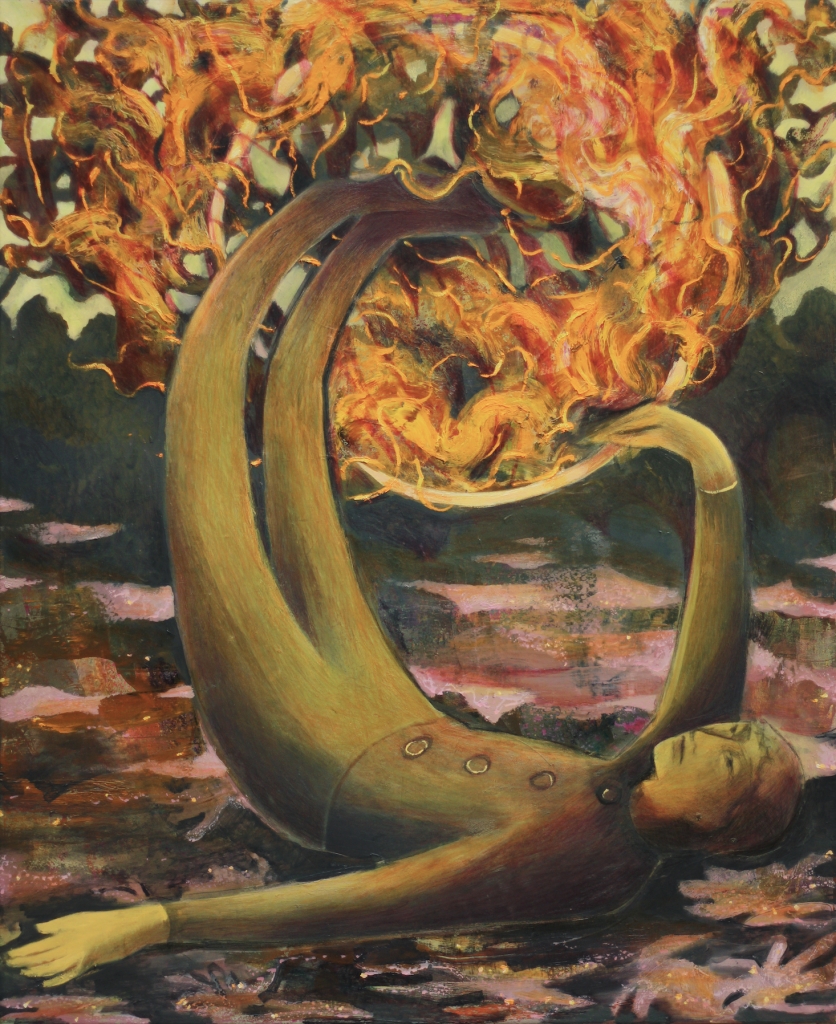
Luca Ceccherini, Gli imbroglioni, 2026, techniques mixtes sur toile, 80 x 90 cm
 The paintings in this exhibition appear as a circus of figures arrived from an indefinite time. A caravan of strangeness, medieval and at the same time contemporary, deeply Italian and yet from nowhere in particular. 

Now the characters come forward, one by one. 

Acrobats, tricksters, tightrope walkers, fire-eaters, guardians of small coins, fools and scoundrels. The world Ceccherini paints is the world of the excluded, of the strolling players, of those who live at the margins and for that reason look at the centre from an unexpected angle. 

Certainly, at times, these bizarre figures seem familiar too. 

They are what Ceccherini calls “nostalgic references.” Not citations, not homages — something closer to the way a flavour returns without your knowing anymore where you first tasted it. A mixture of things seen, absorbed, chewed, probably never properly digested, which resurfaces in his diaries, sometimes finding a precise name, sometimes not. 

And in any case, he accepts them. With an almost fraternal gesture, he makes room for them in the story, on the canvas. 

From here on, the figures ask to be looked at, more closely. 

In the case of Il taglio della veste (2026), the reference lies only a few steps from this gallery: a Crucifixion from the workshop of Giotto, painted in Naples around 1330 and now held in the Louvre. Ceccherini takes from it the group of holy women at the foot of the cross — the bending bodies, the hands searching for one another, a white cloth passing between the figures in a gesture of mourning and ritual — and transfers it into a bucolic backdrop from which every sacred coordinate has disappeared. The gesture remains. The cloth remains. That circular form of women gathered around something at once powerful and fragile remains. The specific story dissolves, but its emotional structure remains intact — open, perhaps liberated, because now it no longer belongs to a single, univocal narrative. 

In Baruffa (2026), the reference is an early drawing by Marino Marini — not the Marini the world knows, the archetypal horseman fixed in his monumentality, but Marini before the myth solidified, when bodies and animals piled up on paper in a confusion without hierarchy: who falls, who rises, and meanwhile who is beast and who is human is not yet clear. 

The figure falling from the horse in Marini’s drawing — the one that finds itself holding itself up on its hands, in an instant suspended between flight and ground — continues to haunt Ceccherini. It reappears in two works in the exhibition, as though the artist had wanted to follow it through time, to see where it would end up. 

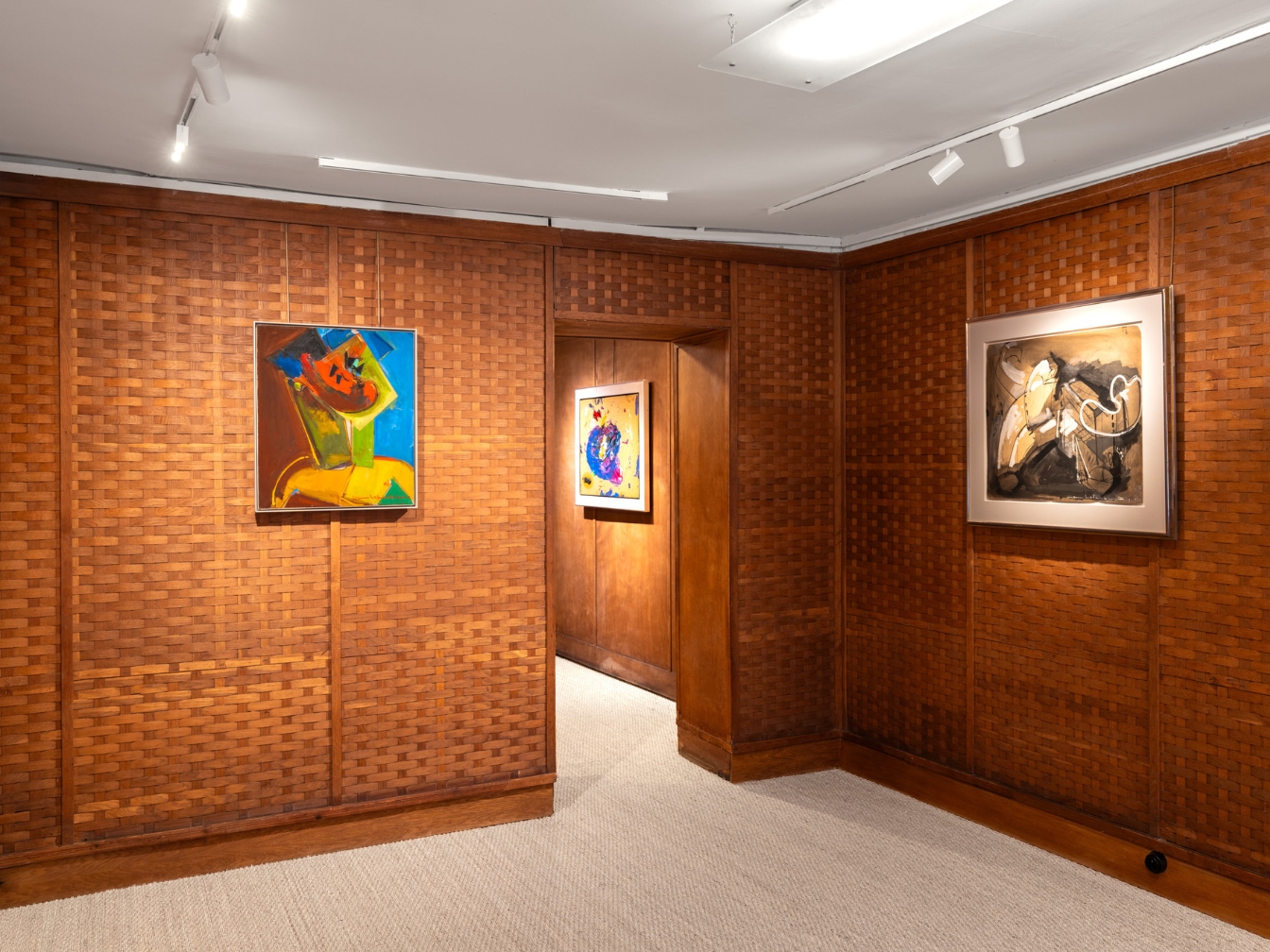
In Acrobata (2026), the fall has redeemed itself: the body has learned to transform its own imbalance into spectacle, and the surrounding landscape dissolves into a silent applause of petals and fragments. In Tentando di non bruciarsi (2026), the story goes differently: the body has closed in on itself in a circle, a perfect and restless O, while flames erupt from within. 

The acrobat meets fire. 
Whether or not it is managing — not to burn — is exactly what the painting refuses to say. 

Then there are the small works, the ones you look at from close up, almost wanting to take them in your hands. I guardiani delle monetine (2026): a large, quiet face recalling Pompeian painting — the frescoes of the House of the Fruit Orchard, a domus where the most precious paintings were not in the reception rooms but in the cubicula, the bedrooms, for few eyes. It is instead for the eyes of many that other characters paint their faces, put on makeup, ignite themselves with colours that are at times exaggerated, breaking Ceccherini’s muted palette and interrupting the fluid grammar of his brushwork with a long line of eyeliner. A mark that seems granted by the artist to help them disguise themselves, hide themselves, or perhaps construct their own identity.

Luca Ceccherini, Tentando di non bruciarsi, 2026, techniques mixtes sur toile, 108 x 88 cm

 And yes, perhaps you did not know his work.
You did not know what this strange language he speaks was.
And yet there is something of you in those canvases.

With a shy smile, perhaps drawing himself into a typical shrug, Ceccherini has stolen the way you have always told yourselves the most necessary stories and put it into painting: something happens, there are consequences, and meanwhile life goes on. And in the end, Fo wrote, what remains is “a marvellous fleeting occasion, to be seized on the wing.

Signore e signori
Buon Grammelot

_Giorgia Aprosio

 If Propp showed, at the beginning of the twentieth century, that many stories are, deep down, made of the same atoms, revealing how the essence of the folktale lies more in structure than in plot, Dario Fo demonstrated, halfway through the last century, that stories can be told without needing to use even a single “real” word. 

Actor, playwright, painter, cultural agitator, winner of the Nobel Prize in Literature in 1997, Fo created his masterpiece in 1969, Mistero Buffo: a performance in which, alone on stage, he reworked medieval and apocryphal texts, interpreting all the characters involved through an invented language he called grammelot. 

The etymology of the term remains uncertain — and perhaps precisely for that reason, perfect. It probably derives from the French grommeler — to grumble, to mutter — though some have read in it a mixture of grammaire, mêler and argot: grammar, blending, slang. In any case, grammelot is a non-language language, a theatrical mixture of sounds, rhythms, cadences, onomatopoeia, mime and gesture that, in some sense, was born long before Fo, long before that name. 

The players of the commedia dell’arte used it as they passed through the courts of France; the Venetians distorted it into gramlotto; jesters turned it into a comic and satirical instrument: a language capable of mocking power, and at times of eluding it, because it is difficult to censor a text that formally does not exist. A language, in short, that means nothing and precisely for this reason can be made to speak of everything. 

And it is no coincidence that it now gives its name to Ceccherini’s first solo exhibition in France.
Dina Vierny Luca Ceccherini, Offerta libera, 2026, Techniques mixtes sur toile, 90 x 80 cm

Luca Ceccherini - Grammelot

27.05.2026
 
 Galerie Dina Vierny is delighted to present the first solo exhibition in France by the Italian painter Luca Ceccherini (b. 1993). Titled Grammelot, this summer exhibition, featuring a collection of previously unseen works, will run from June 5 to July 29  at our gallery at 53 Rue de Seine.
Giorgia Aprosio, 
critique d’art et commissaire d’exposition

There is something paradoxical about writing a critical text on Grammelot, Luca Ceccherini’s first solo exhibition in France at Dina Vierny: a body of work that, in its deepest substance, calls into question the very necessity of the language I am using to write it. 

These very lines are, after all, the offspring of centuries of language, and with it of grammatical rules, academic corrections — of the entire apparatus of bella scrittura and bella lingua that a civilisation constructs in order to say things as they should be said, or rather, as they must be said. 

And yet there exists a way of communicating that precedes all grammar, every academy, every acquired vocabulary. And if it is true that we are not surprised when someone reminds us of this, it is also true that the harder task remains understanding what, really, it consists of. 

Music tries, and sometimes succeeds. So do dance, theatre, and occasionally a certain kind of painting. In Luca Ceccherini’s case, painting does not explain this older form of communication: it makes it happen again.

Ceccherini was born in Arezzo — a biographical fact irrelevant in itself, were it not for the subtle irony that ties him to a land from which some of the founding myths of the Italian language originate: Dante, Petrarch, Boccaccio. But if a certain genealogy of Italian literature begins symbolically here, it is equally true that Arezzo is the city of Pietro Aretino, the most irreverent Italian writer of the sixteenth century, a man who preferred the living nature of the word to linguistic convention.

As though this land had always generated, in equal measure, language and its saboteur.

It is difficult to say whether Ceccherini belongs to the first genealogy or the second. What is certain is only that he was born in the geographical cradle of a particular kind of word — the measured word, the learned word, the written word, and sometimes the painted word. The same word that runs through the limpid geometries of Piero della Francesca, that suspended light and that human proportion which seem to stop time. But Ceccherini then moves to Venice, where, in the Scuola Grande di San Rocco, Tintoretto painted as though the world were collapsing: bodies in torsion, oblique and sharpened light, narratives dense with physical and moral drama that turn silence into noise. He arrives, finally, in Turin, in the refined and melancholic sensibility of a city that has long lived culture as both a shield and a mirror.

Somehow, all of these geographies have acted upon the heart of his painting without it ever coming to belong fully to any of them. The images seen, the atmospheres crossed, the cities lived through become elements grafted onto a landscape which, if we really had to recognise it, would certainly be the Tuscan landscape of origin — but which in Ceccherini is never a view, becoming instead a theatrical backdrop: not a place to contemplate, but the scene upon which, at a certain point, something happens. 

No word yet. 
And yet something has already begun. 

And when it happens, it has a precise structure. 

Vladimir Propp, the Russian folklorist, published his Morphology of the Folktale in 1928, a study demonstrating that beneath the apparent variety of folk narratives lies a limited number of recurring narrative functions, always the same, always in the same order: departure, trial, transgression, punishment, reward. As though the stories humanity tells were an infinite series of variations built upon ancient structures.

Ceccherini works exactly at this level. The stories he tells in painting are never specific, and yet they feel familiar because, deep down, we already know their grammar. He takes iconic elements deposited in the heritage of the collective imagination — the jester, the trickster, the acrobat, the fortune-teller, the fire-eater, the tightrope walker — empties them of their cultural origin, and returns them as containers of meaning. Il carretto dell’indovina (2026), Baruffa (2026), Cattivi consigli (2026), Pessimo attore (2026): each title is a minimal episode, an action and its consequence, something that has always happened among human beings.	
 If Propp showed, at the beginning of the twentieth century, that many stories are, deep down, made of the same atoms, revealing how the essence of the folktale lies more in structure than in plot, Dario Fo demonstrated, halfway through the last century, that stories can be told without needing to use even a single “real” word. 

Actor, playwright, painter, cultural agitator, winner of the Nobel Prize in Literature in 1997, Fo created his masterpiece in 1969, Mistero Buffo: a performance in which, alone on stage, he reworked medieval and apocryphal texts, interpreting all the characters involved through an invented language he called grammelot. 

The etymology of the term remains uncertain — and perhaps precisely for that reason, perfect. It probably derives from the French grommeler — to grumble, to mutter — though some have read in it a mixture of grammaire, mêler and argot: grammar, blending, slang. In any case, grammelot is a non-language language, a theatrical mixture of sounds, rhythms, cadences, onomatopoeia, mime and gesture that, in some sense, was born long before Fo, long before that name. 

The players of the commedia dell’arte used it as they passed through the courts of France; the Venetians distorted it into gramlotto; jesters turned it into a comic and satirical instrument: a language capable of mocking power, and at times of eluding it, because it is difficult to censor a text that formally does not exist. A language, in short, that means nothing and precisely for this reason can be made to speak of everything. 

And it is no coincidence that it now gives its name to Ceccherini’s first solo exhibition in France.

Luca Ceccherini, Astanti, 2026, techniques mixtes sur toile, 90 x 80 cm

 In this exhibition, there is little to understand. The advice, in fact, is to stop trying at once. Better to surrender, as one does before a child and their unknown language, which nonetheless seems, strangely, to be saying something to you. 

Fo wrote as much in Il manuale minimo dell’attore (1987), speaking precisely of grammelot: “It is impossible to lay down rules. One must go by intuition, by an almost subterranean knowledge.” 

But perhaps I have not convinced you yet. 

In the same text, he tells of witnessing a dialogue between a Neapolitan boy and an English boy who, having no language in common, invented one of their own. The Neapolitan pretended to speak English; the English boy pretended to speak southern Italian. They understood each other perfectly. Through varied cadences, gestures and babbling, they had built a code.

The hundreds of stories they had absorbed — fairy tales, cartoons, comedies, comics — had prepared them for that moment: to read an entirely new situation, even without intelligible words. Nothing to do with Esperanto, the artificial language pursued so stubbornly by the twentieth century, but rather a primitive, pre-grammatical language, made of shared narrative structures, recognisable gestures, sequences the human brain can read before it has learned any alphabet.

The language of everyone.
The language of everything. 

And perhaps, precisely for this reason, the only instrument suited to facing that mistero buffo that is the world.

Luca Ceccherini, Gli imbroglioni, 2026, techniques mixtes sur toile, 80 x 90 cm

 The paintings in this exhibition appear as a circus of figures arrived from an indefinite time. A caravan of strangeness, medieval and at the same time contemporary, deeply Italian and yet from nowhere in particular. 

Now the characters come forward, one by one. 

Acrobats, tricksters, tightrope walkers, fire-eaters, guardians of small coins, fools and scoundrels. The world Ceccherini paints is the world of the excluded, of the strolling players, of those who live at the margins and for that reason look at the centre from an unexpected angle. 

Certainly, at times, these bizarre figures seem familiar too. 

They are what Ceccherini calls “nostalgic references.” Not citations, not homages — something closer to the way a flavour returns without your knowing anymore where you first tasted it. A mixture of things seen, absorbed, chewed, probably never properly digested, which resurfaces in his diaries, sometimes finding a precise name, sometimes not. 

And in any case, he accepts them. With an almost fraternal gesture, he makes room for them in the story, on the canvas. 

From here on, the figures ask to be looked at, more closely. 

In the case of Il taglio della veste (2026), the reference lies only a few steps from this gallery: a Crucifixion from the workshop of Giotto, painted in Naples around 1330 and now held in the Louvre. Ceccherini takes from it the group of holy women at the foot of the cross — the bending bodies, the hands searching for one another, a white cloth passing between the figures in a gesture of mourning and ritual — and transfers it into a bucolic backdrop from which every sacred coordinate has disappeared. The gesture remains. The cloth remains. That circular form of women gathered around something at once powerful and fragile remains. The specific story dissolves, but its emotional structure remains intact — open, perhaps liberated, because now it no longer belongs to a single, univocal narrative. 

In Baruffa (2026), the reference is an early drawing by Marino Marini — not the Marini the world knows, the archetypal horseman fixed in his monumentality, but Marini before the myth solidified, when bodies and animals piled up on paper in a confusion without hierarchy: who falls, who rises, and meanwhile who is beast and who is human is not yet clear. 

The figure falling from the horse in Marini’s drawing — the one that finds itself holding itself up on its hands, in an instant suspended between flight and ground — continues to haunt Ceccherini. It reappears in two works in the exhibition, as though the artist had wanted to follow it through time, to see where it would end up. 

In Acrobata (2026), the fall has redeemed itself: the body has learned to transform its own imbalance into spectacle, and the surrounding landscape dissolves into a silent applause of petals and fragments. In Tentando di non bruciarsi (2026), the story goes differently: the body has closed in on itself in a circle, a perfect and restless O, while flames erupt from within. 

The acrobat meets fire. 
Whether or not it is managing — not to burn — is exactly what the painting refuses to say. 

Then there are the small works, the ones you look at from close up, almost wanting to take them in your hands. I guardiani delle monetine (2026): a large, quiet face recalling Pompeian painting — the frescoes of the House of the Fruit Orchard, a domus where the most precious paintings were not in the reception rooms but in the cubicula, the bedrooms, for few eyes. It is instead for the eyes of many that other characters paint their faces, put on makeup, ignite themselves with colours that are at times exaggerated, breaking Ceccherini’s muted palette and interrupting the fluid grammar of his brushwork with a long line of eyeliner. A mark that seems granted by the artist to help them disguise themselves, hide themselves, or perhaps construct their own identity.

Luca Ceccherini, Tentando di non bruciarsi, 2026, techniques mixtes sur toile, 108 x 88 cm

                And yes, perhaps you did not know his work.
You did not know what this strange language he speaks was.
And yet there is something of you in those canvases.

With a shy smile, perhaps drawing himself into a typical shrug, Ceccherini has stolen the way you have always told yourselves the most necessary stories and put it into painting: something happens, there are consequences, and meanwhile life goes on. And in the end, Fo wrote, what remains is “a marvellous fleeting occasion, to be seized on the wing.

Signore e signori
Buon Grammelot

_Giorgia Aprosio
            

Don't miss any of our news, subscribe to our newsletter!

    Ne ratez rien de nos actualités, abonnez-vous à notre newsletter !