
All Exhibitions here

Edgar Sarin - Pow. R. Toc H.

 
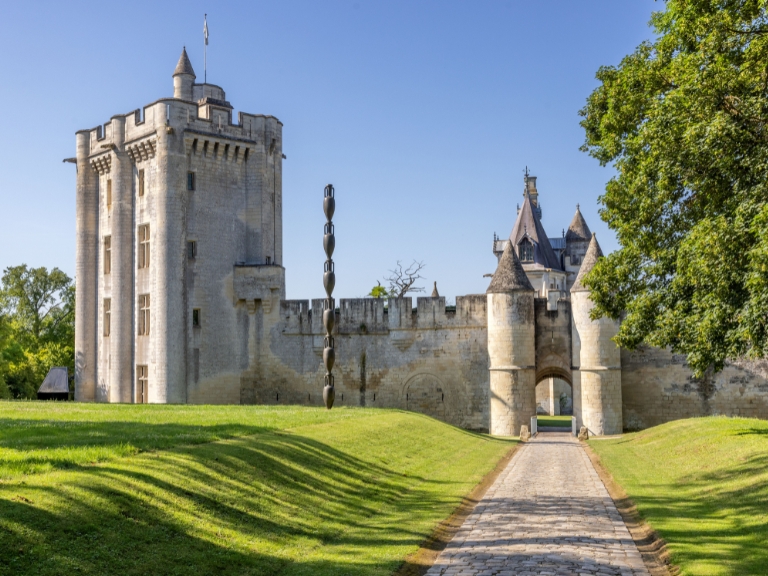
 For Edgar Sarin, the exhibition is much more than a simple display: it is a living system that evolves through different states of equilibrium. In the heart of the historic chapel of the Donjon de Vez, completed at the end of the 14th century, the artist employs strategies of occupation that engage in a dialogue with the spirit of the place. Mathilde de Croix, curator of the exhibition Edgar Sarin—Pow. R. Toc H., organized in collaboration with Galerie Dina Vierny, introduces us to this unique encounter between contemporary art and medieval heritage.
04.07.2026
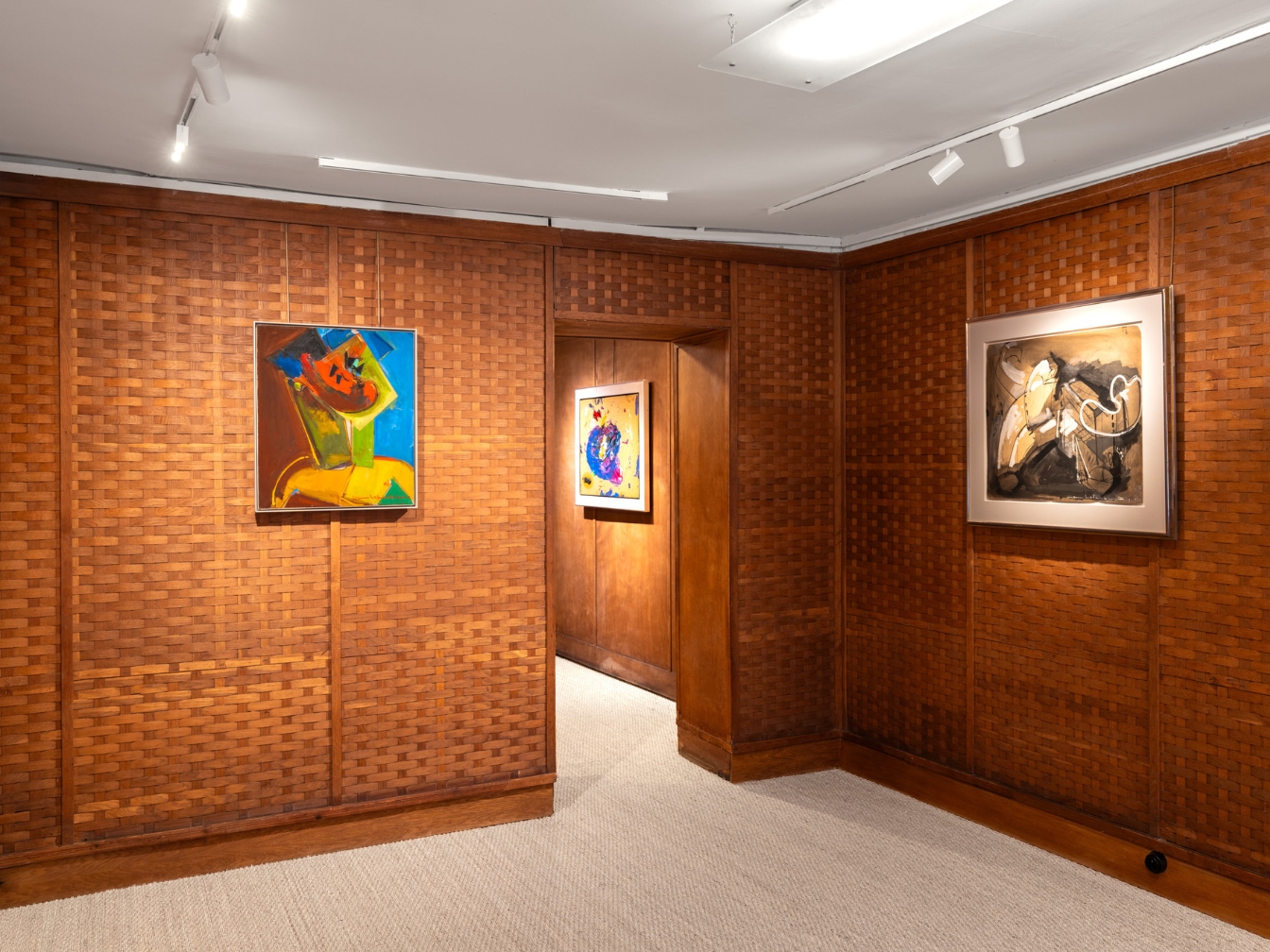
Dina Vierny View of Edgar Sarin's exhibition - Pow. R. Toc H. at the Donjon de Vez © Romain Darnaud
Edgar Sarin, born in 1989, moves from painting to sculpture to installation in a continuous flow — so many mediums, materials and spaces, where one gesture sets off another. This porousness between works is reinforced by an idea of proximity: proximity to a place, to a context, to whatever is at hand.

The exhibition is, for him, at once a vast artificial, carefully prepared system and a living organism that tends toward its own autonomy, its own existence. He deploys strategies of occupation which, as time passes, assert themselves as a will to settle into a space, caught in the tension between putting down roots and forced exile.
In the chapel of the Donjon de Vez, where every space remains bound to its original function — a place of worship — and stands autonomous through its architectural qualities, he tests several recurring principles for inhabiting a space, oscillating between a defined system and spontaneous gesture.

The first takes shape outside the Donjon's ramparts, with the installation of the monumental sculpture Bronze aux amphores (2026). These vessels — an archetypal form whose original function has lapsed — once meant for storing and transporting goods, are here immobilized by a twofold gesture: cast in bronze, then stacked one atop the other.

The exhibition's title, borrowed from an instrumental piece by Pink Floyd, punctuated in its first half by assorted cries and sound effects, sets the tone for the show as a deliberate absence: a title chosen simply because it sounds right, and a track that is nowhere to be heard.	
View of Edgar Sarin's exhibition - Pow. R. Toc H. at the Donjon de Vez © Romain Darnaud

 CHAPELLER 

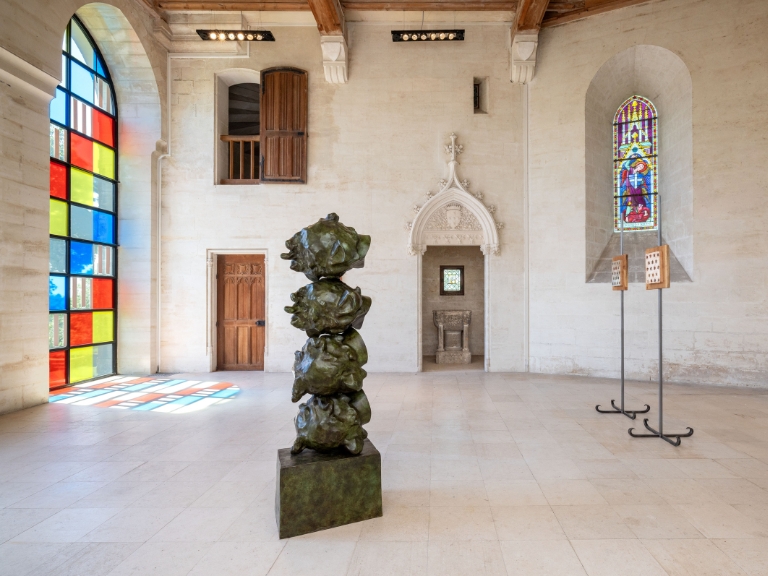
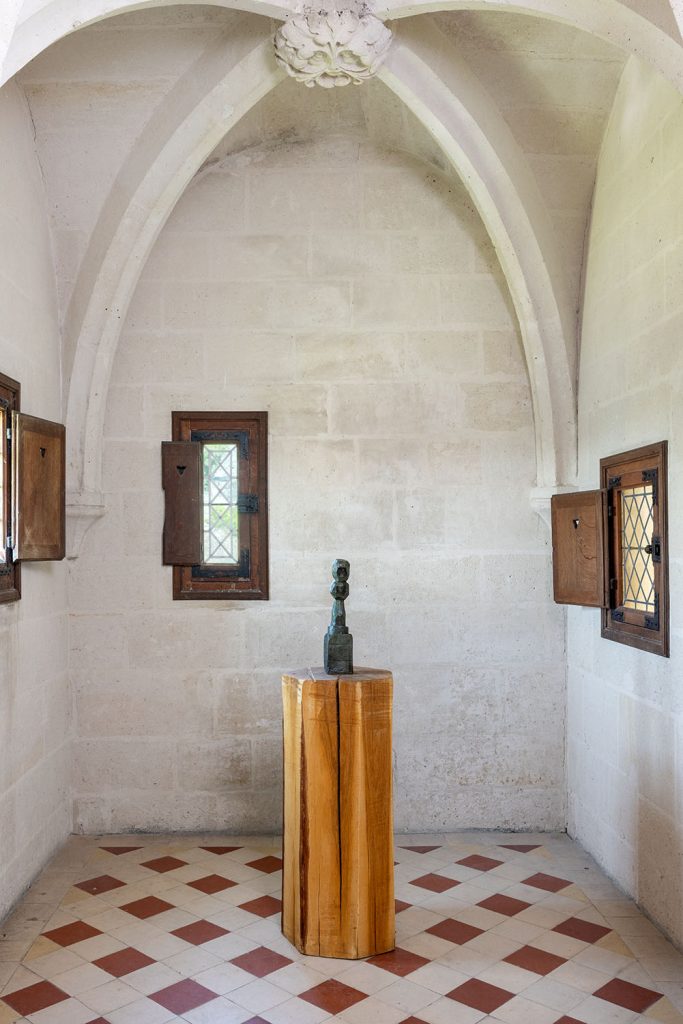
The chapel of the Donjon de Vez is a charged space, where different functions, symbols, layers of time and material works all coexist. Edgar Sarin slips in a presence, so as to preserve both the space and its occupants.

With Héroïque égyptienne (2026), the artist continues his exploration of gravity, in which the juxtaposition of elements produces states of equilibrium that never quite settle. The move to bronze permanently fixes this new typology of gesture, much as with Bronze aux amphores, installed outside the ramparts. Also cast in bronze, Héroïque égyptienne takes as its starting point a head sculpted by Aristide Maillol, reproduced four times. The balance between void and mass, between hollow and relief, allows the artist to stack them with unexpected stability. Through this gesture, he reveals how the geometry of a face is perceived differently depending on the vantage point.

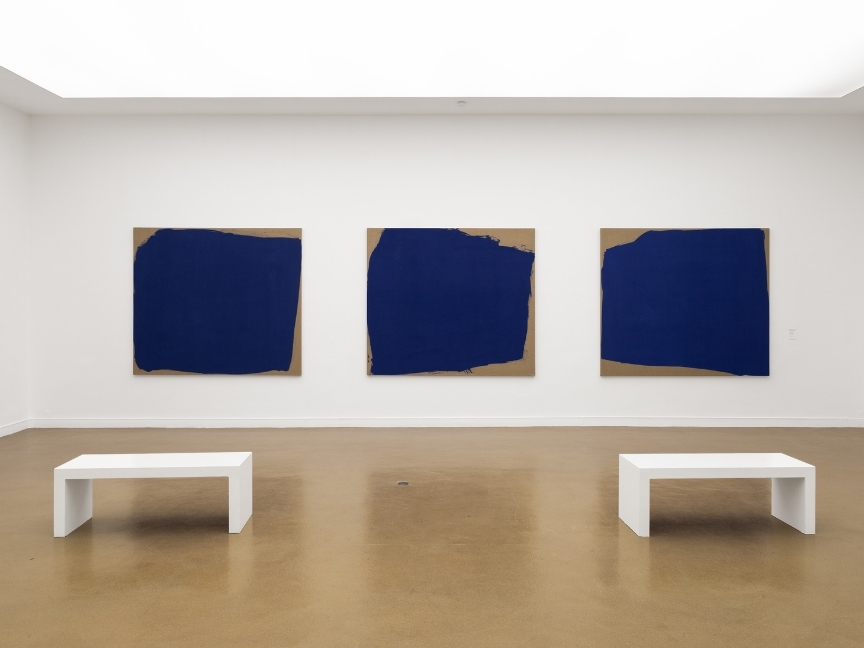
The two paintings Hildegard von Bingen series (2026) originate in the motif of starred ceilings, used since Early Christian times to symbolize the celestial vault, and echo the visions of the mystic figure whose name the paintings bear. As the starting point of a series, these two works stem from a recurring practice of the artist's: drawing on the walls of his own architectural constructions throughout the run of his earliest exhibitions. Returning to his own paintings — monochromes or landscapes — Edgar Sarin strips away matter, engraves it, scores it, entirely transforming the original work, or, put another way, drawing out another reality from what was already there.

These two gestures unfold in two stages and evoke the shift between a starting work — whether or not it is the artist's own — and the calibration of a system oscillating between a recurring principle (stacking or engraving) and chance.

By letting the presence of each work simply arise, Sarin perhaps allows the visitor to pass through this place and begin truly to inhabit it.

View of Edgar Sarin's exhibition - Pow. R. Toc H. at the Donjon de Vez © Romain Darnaud

 SALLE DES GARDES

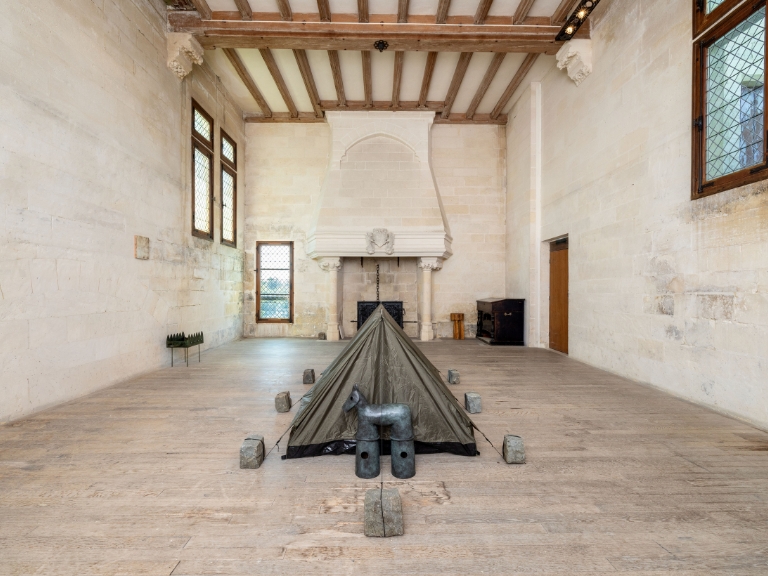
The chapel of the Donjon de Vez is a charged space, where different functions, symbols, layers of time and material works all coexist. Edgar Sarin slips in a presence, so as to preserve both the space and its occupants.

With Héroïque égyptienne (2026), the artist continues his exploration of gravity, in which the juxtaposition of elements produces states of equilibrium that never quite settle. The move to bronze permanently fixes this new typology of gesture, much as with Bronze aux amphores, installed outside the ramparts. Also cast in bronze, Héroïque égyptienne takes as its starting point a head sculpted by Aristide Maillol, reproduced four times. The balance between void and mass, between hollow and relief, allows the artist to stack them with unexpected stability. Through this gesture, he reveals how the geometry of a face is perceived differently depending on the vantage point.

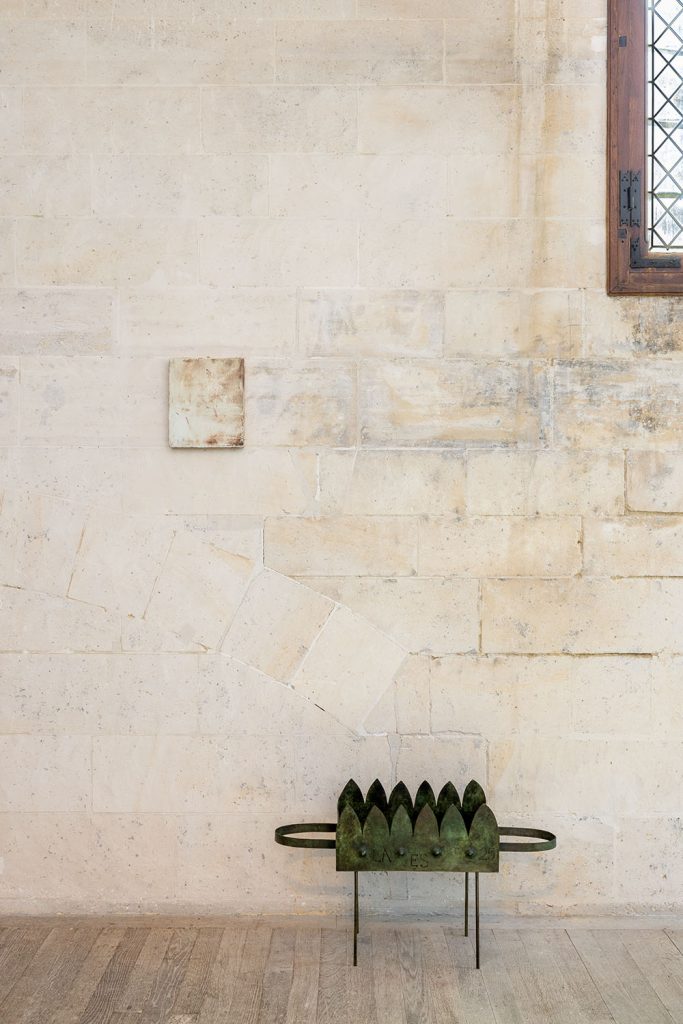
The two paintings Hildegard von Bingen series (2026) originate in the motif of starred ceilings, used since Early Christian times to symbolize the celestial vault, and echo the visions of the mystic figure whose name the paintings bear. As the starting point of a series, these two works stem from a recurring practice of the artist's: drawing on the walls of his own architectural constructions throughout the run of his earliest exhibitions. Returning to his own paintings — monochromes or landscapes — Edgar Sarin strips away matter, engraves it, scores it, entirely transforming the original work, or, put another way, drawing out another reality from what was already there.

These two gestures unfold in two stages and evoke the shift between a starting work — whether or not it is the artist's own — and the calibration of a system oscillating between a recurring principle (stacking or engraving) and chance.
By letting the presence of each work simply arise, Sarin perhaps allows the visitor to pass through this place and begin truly to inhabit it.

View of Edgar Sarin's exhibition - Pow. R. Toc H. at the Donjon de Vez © Romain Darnaud

View of Edgar Sarin's exhibition - Pow. R. Toc H. at the Donjon de Vez © Romain Darnaud

  EIFFEL ROOM

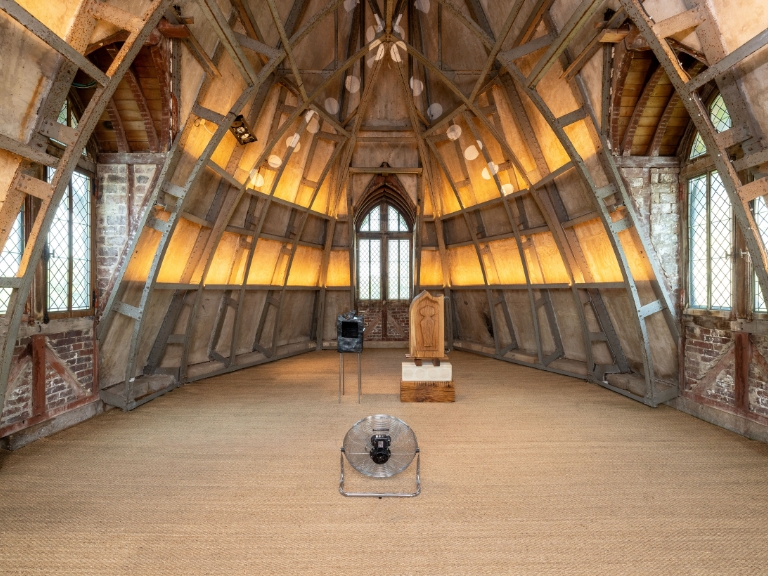
In this room beneath the eaves, open to the sky, shaped like a ship's prow, its metal framework designed by Gustave Eiffel, Edgar Sarin places two sculptures: a small-scale Sarcophage (2025) and Nouveau Monument (2026), conceived from a Gallo-Roman ex-voto. Both attest to the survival of functional objects that once forged a connection between the world of mortals and that of the divine.

In front of these sculptures, a fan sets the air in motion, making it palpable and tangible, underscoring the imprint a work leaves upon a space, like a furrow traced across the sky.

Through this improvised gesture, the artist shifts the symbolism of these objects of passage. He draws attention to the moment when the "Almost-nothing" theorized by Vladimir Jankélévitch occurs, offering us the chance to "glimpse what exists only in the doing and the being-done" — that "invisible, ambiguous, non-existent element"; "that which is missing when, at least in appearance, nothing is missing at all."
 Listed as a Historic Monument in 1906, the Donjon de Vez is a landmark of French heritage. Set in the heart of the Oise, a genuine medieval fortress with its walls, curtain walls and machicolations, the Donjon de Vez became, in 1987, a site dedicated to contemporary creation. Home to an ensemble of monumental sculptures, the Donjon and its grounds — awarded the "Jardin Remarquable" label by the Ministry of Culture in 2007 — benefit from a distinctive presentation combining site-specific installations with feudal architecture.

The Donjon de Vez brings together heritage and modernity, like an interstice between the medieval and the contemporary.

Mathilde de Croix, exhibition curator

View of Edgar Sarin's exhibition - Pow. R. Toc H. at the Donjon de Vez © Romain Darnaud

 
 CHAPELLER 

The chapel of the Donjon de Vez is a charged space, where different functions, symbols, layers of time and material works all coexist. Edgar Sarin slips in a presence, so as to preserve both the space and its occupants.

With Héroïque égyptienne (2026), the artist continues his exploration of gravity, in which the juxtaposition of elements produces states of equilibrium that never quite settle. The move to bronze permanently fixes this new typology of gesture, much as with Bronze aux amphores, installed outside the ramparts. Also cast in bronze, Héroïque égyptienne takes as its starting point a head sculpted by Aristide Maillol, reproduced four times. The balance between void and mass, between hollow and relief, allows the artist to stack them with unexpected stability. Through this gesture, he reveals how the geometry of a face is perceived differently depending on the vantage point.

The two paintings Hildegard von Bingen series (2026) originate in the motif of starred ceilings, used since Early Christian times to symbolize the celestial vault, and echo the visions of the mystic figure whose name the paintings bear. As the starting point of a series, these two works stem from a recurring practice of the artist's: drawing on the walls of his own architectural constructions throughout the run of his earliest exhibitions. Returning to his own paintings — monochromes or landscapes — Edgar Sarin strips away matter, engraves it, scores it, entirely transforming the original work, or, put another way, drawing out another reality from what was already there.

These two gestures unfold in two stages and evoke the shift between a starting work — whether or not it is the artist's own — and the calibration of a system oscillating between a recurring principle (stacking or engraving) and chance.

By letting the presence of each work simply arise, Sarin perhaps allows the visitor to pass through this place and begin truly to inhabit it.
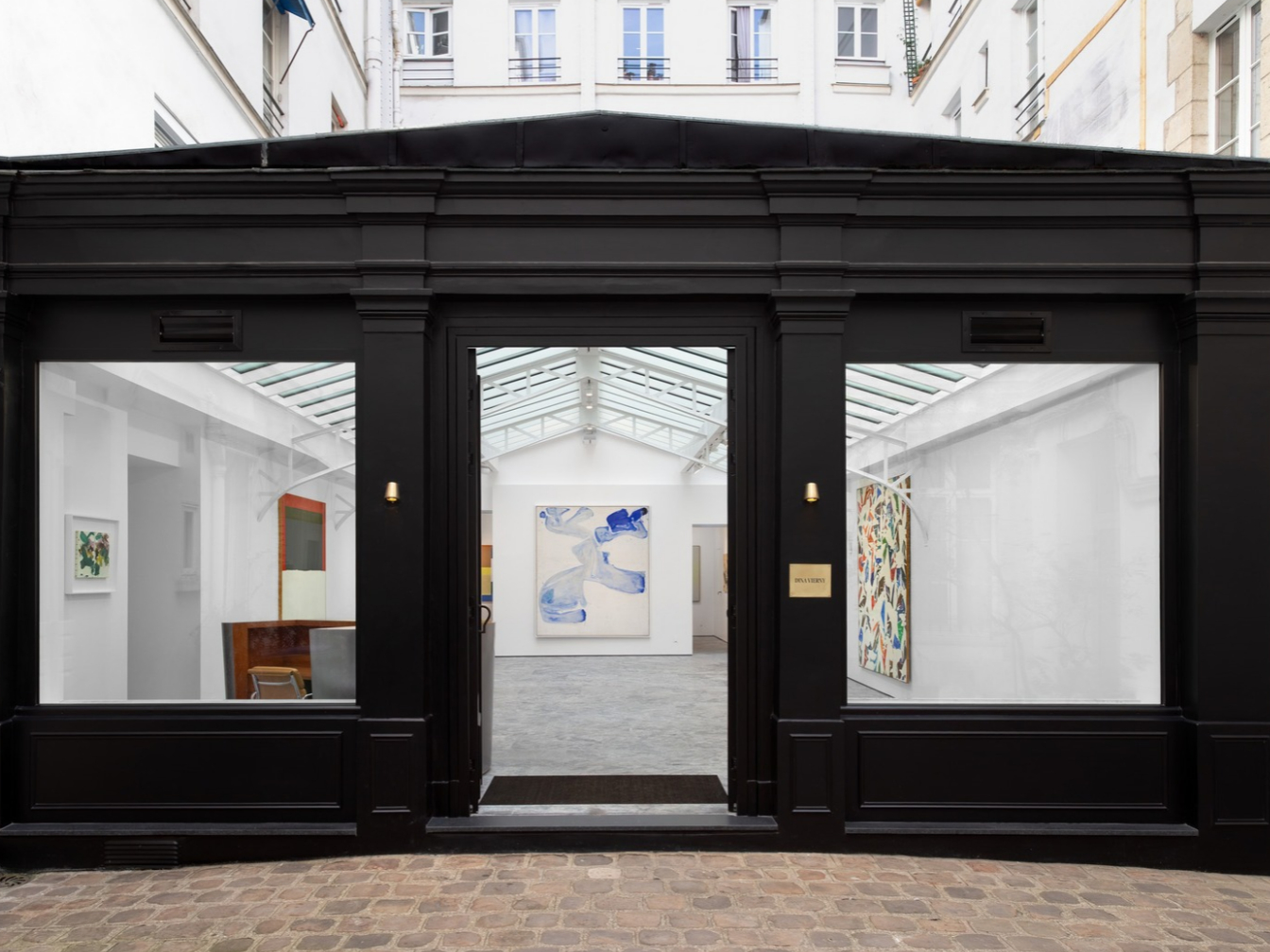
Dina Vierny View of Edgar Sarin's exhibition - Pow. R. Toc H. at the Donjon de Vez © Romain Darnaud

Edgar Sarin - Pow. R. Toc H.

04.07.2026
 
 For Edgar Sarin, the exhibition is much more than a simple display: it is a living system that evolves through different states of equilibrium. In the heart of the historic chapel of the Donjon de Vez, completed at the end of the 14th century, the artist employs strategies of occupation that engage in a dialogue with the spirit of the place. Mathilde de Croix, curator of the exhibition Edgar Sarin—Pow. R. Toc H., organized in collaboration with Galerie Dina Vierny, introduces us to this unique encounter between contemporary art and medieval heritage.
Edgar Sarin, born in 1989, moves from painting to sculpture to installation in a continuous flow — so many mediums, materials and spaces, where one gesture sets off another. This porousness between works is reinforced by an idea of proximity: proximity to a place, to a context, to whatever is at hand.

The exhibition is, for him, at once a vast artificial, carefully prepared system and a living organism that tends toward its own autonomy, its own existence. He deploys strategies of occupation which, as time passes, assert themselves as a will to settle into a space, caught in the tension between putting down roots and forced exile.
In the chapel of the Donjon de Vez, where every space remains bound to its original function — a place of worship — and stands autonomous through its architectural qualities, he tests several recurring principles for inhabiting a space, oscillating between a defined system and spontaneous gesture.

The first takes shape outside the Donjon's ramparts, with the installation of the monumental sculpture Bronze aux amphores (2026). These vessels — an archetypal form whose original function has lapsed — once meant for storing and transporting goods, are here immobilized by a twofold gesture: cast in bronze, then stacked one atop the other.

The exhibition's title, borrowed from an instrumental piece by Pink Floyd, punctuated in its first half by assorted cries and sound effects, sets the tone for the show as a deliberate absence: a title chosen simply because it sounds right, and a track that is nowhere to be heard.	
 CHAPELLER 

The chapel of the Donjon de Vez is a charged space, where different functions, symbols, layers of time and material works all coexist. Edgar Sarin slips in a presence, so as to preserve both the space and its occupants.

With Héroïque égyptienne (2026), the artist continues his exploration of gravity, in which the juxtaposition of elements produces states of equilibrium that never quite settle. The move to bronze permanently fixes this new typology of gesture, much as with Bronze aux amphores, installed outside the ramparts. Also cast in bronze, Héroïque égyptienne takes as its starting point a head sculpted by Aristide Maillol, reproduced four times. The balance between void and mass, between hollow and relief, allows the artist to stack them with unexpected stability. Through this gesture, he reveals how the geometry of a face is perceived differently depending on the vantage point.

The two paintings Hildegard von Bingen series (2026) originate in the motif of starred ceilings, used since Early Christian times to symbolize the celestial vault, and echo the visions of the mystic figure whose name the paintings bear. As the starting point of a series, these two works stem from a recurring practice of the artist's: drawing on the walls of his own architectural constructions throughout the run of his earliest exhibitions. Returning to his own paintings — monochromes or landscapes — Edgar Sarin strips away matter, engraves it, scores it, entirely transforming the original work, or, put another way, drawing out another reality from what was already there.

These two gestures unfold in two stages and evoke the shift between a starting work — whether or not it is the artist's own — and the calibration of a system oscillating between a recurring principle (stacking or engraving) and chance.

By letting the presence of each work simply arise, Sarin perhaps allows the visitor to pass through this place and begin truly to inhabit it.

View of Edgar Sarin's exhibition - Pow. R. Toc H. at the Donjon de Vez © Romain Darnaud

 SALLE DES GARDES

The chapel of the Donjon de Vez is a charged space, where different functions, symbols, layers of time and material works all coexist. Edgar Sarin slips in a presence, so as to preserve both the space and its occupants.

With Héroïque égyptienne (2026), the artist continues his exploration of gravity, in which the juxtaposition of elements produces states of equilibrium that never quite settle. The move to bronze permanently fixes this new typology of gesture, much as with Bronze aux amphores, installed outside the ramparts. Also cast in bronze, Héroïque égyptienne takes as its starting point a head sculpted by Aristide Maillol, reproduced four times. The balance between void and mass, between hollow and relief, allows the artist to stack them with unexpected stability. Through this gesture, he reveals how the geometry of a face is perceived differently depending on the vantage point.

The two paintings Hildegard von Bingen series (2026) originate in the motif of starred ceilings, used since Early Christian times to symbolize the celestial vault, and echo the visions of the mystic figure whose name the paintings bear. As the starting point of a series, these two works stem from a recurring practice of the artist's: drawing on the walls of his own architectural constructions throughout the run of his earliest exhibitions. Returning to his own paintings — monochromes or landscapes — Edgar Sarin strips away matter, engraves it, scores it, entirely transforming the original work, or, put another way, drawing out another reality from what was already there.

These two gestures unfold in two stages and evoke the shift between a starting work — whether or not it is the artist's own — and the calibration of a system oscillating between a recurring principle (stacking or engraving) and chance.
By letting the presence of each work simply arise, Sarin perhaps allows the visitor to pass through this place and begin truly to inhabit it.

View of Edgar Sarin's exhibition - Pow. R. Toc H. at the Donjon de Vez © Romain Darnaud

View of Edgar Sarin's exhibition - Pow. R. Toc H. at the Donjon de Vez © Romain Darnaud
  EIFFEL ROOM

In this room beneath the eaves, open to the sky, shaped like a ship's prow, its metal framework designed by Gustave Eiffel, Edgar Sarin places two sculptures: a small-scale Sarcophage (2025) and Nouveau Monument (2026), conceived from a Gallo-Roman ex-voto. Both attest to the survival of functional objects that once forged a connection between the world of mortals and that of the divine.

In front of these sculptures, a fan sets the air in motion, making it palpable and tangible, underscoring the imprint a work leaves upon a space, like a furrow traced across the sky.

Through this improvised gesture, the artist shifts the symbolism of these objects of passage. He draws attention to the moment when the "Almost-nothing" theorized by Vladimir Jankélévitch occurs, offering us the chance to "glimpse what exists only in the doing and the being-done" — that "invisible, ambiguous, non-existent element"; "that which is missing when, at least in appearance, nothing is missing at all."
 Listed as a Historic Monument in 1906, the Donjon de Vez is a landmark of French heritage. Set in the heart of the Oise, a genuine medieval fortress with its walls, curtain walls and machicolations, the Donjon de Vez became, in 1987, a site dedicated to contemporary creation. Home to an ensemble of monumental sculptures, the Donjon and its grounds — awarded the "Jardin Remarquable" label by the Ministry of Culture in 2007 — benefit from a distinctive presentation combining site-specific installations with feudal architecture.

The Donjon de Vez brings together heritage and modernity, like an interstice between the medieval and the contemporary.

Mathilde de Croix, exhibition curator

View of Edgar Sarin's exhibition - Pow. R. Toc H. at the Donjon de Vez © Romain Darnaud


Don't miss any of our news, subscribe to our newsletter!

    Ne ratez rien de nos actualités, abonnez-vous à notre newsletter !