
Lent by the Galerie Dina Vierny, Aristide Maillol’s 'L’Enfant couronné' is on view in the exhibition “Yellow. Beyond Van Gogh’s Colour” at the Van Gogh Museum in Amsterdam, running through May 17, 2026. This loan contributes to the international recognition of Maillol’s work, which the gallery has consistently championed.25.03.2026
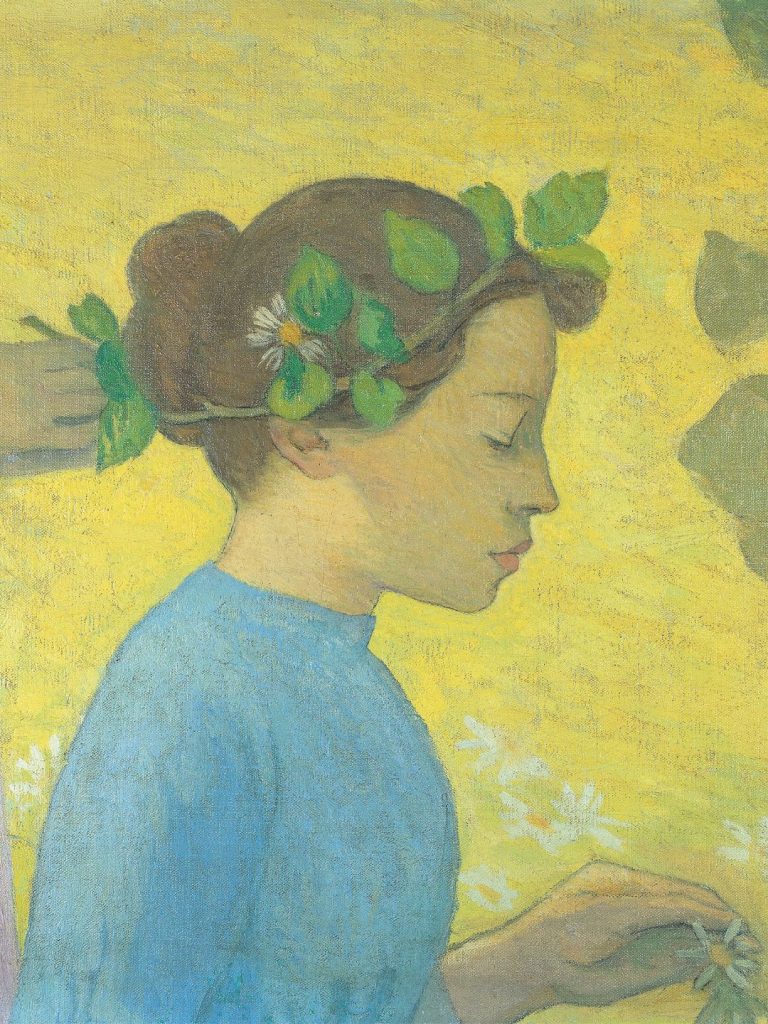
Aristide Maillol, 'L'Enfant couronné', 1892, Oil on canvas, 47 x 40.5 cm Painted in 1892, this oil on canvas isolates the solemn profile of a young girl crowned with flowers against a bright yellow background, rendered in fragmented brushstrokes and dotted with white daisies. This yellow is not one of brilliance or provocation—it is an inner light, serene, almost vegetal, that envelops the figure of the child with closed eyes and lends her an almost sacred dimension. It creates an atmosphere of mystical serenity, reinforced by the stylization of the foliage and the flat background—a deliberate dialogue with the ideas of Gauguin. This painting attests to Maillol’s particularly keen sensitivity to the hidden values of childhood—its purity, its innocence, the silent gravity of the transition to adolescence. The gesture of the wreath of flowers, suspended in time, elevates the scene beyond the anecdotal to make it an image laden with meaning: that of a threshold, a promise, a rite. A few years later, Maillol would continue this same celebration of youth in his sculpture, through magnificently full feminine forms brimming with promise.
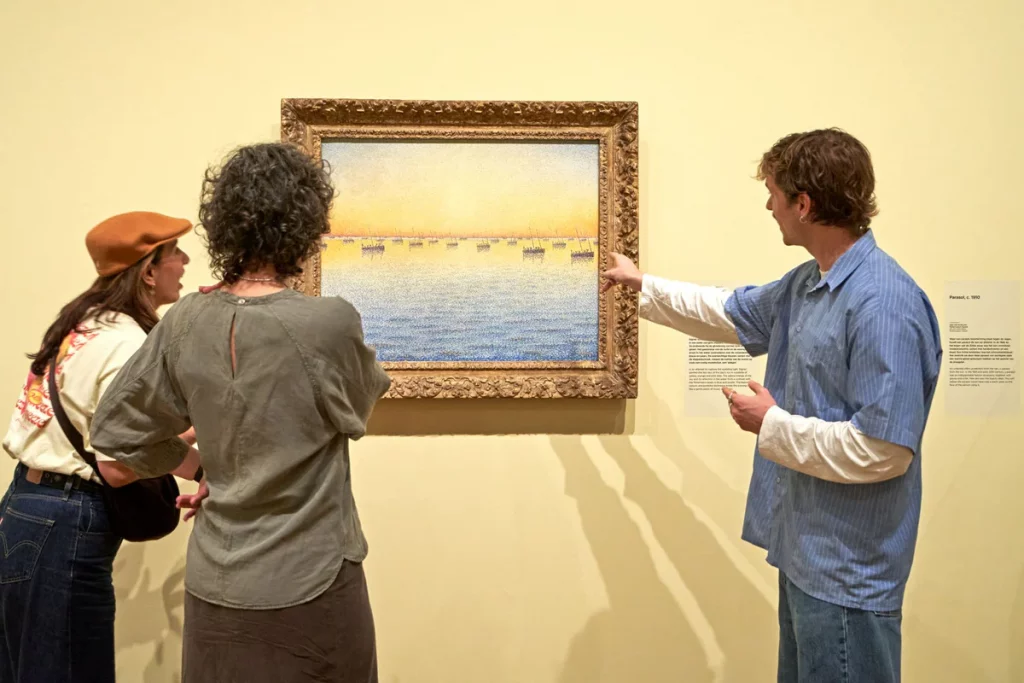

Visitors on a guided tour of the exhibition. Van Gogh Museum. Photo © Michael Floor
('Tout le monde le sait, le jaune, l’orangé et le rouge inspirent et représentent des idées de richesse, de gloire et d’amour.') Baudelaire, 'L’Art romantique', Paris, 1885, p. 11. Reprinted in Œuvres de la Pléiade, 1954, p. 859.
The Van Gogh Museum exhibition, the first of its kind to explore the role of yellow in Van Gogh’s work and that of his contemporaries, brings together artists such as Marc Chagall, William Turner, Wassily Kandinsky, and Hilma af Klint. It explores the many connotations of this color—warmth, courage, renewal—through art, fashion, literature, and music around 1900. It is within this chromatic and historical dialogue that 'L'Enfant couronné' finds its rightful place.

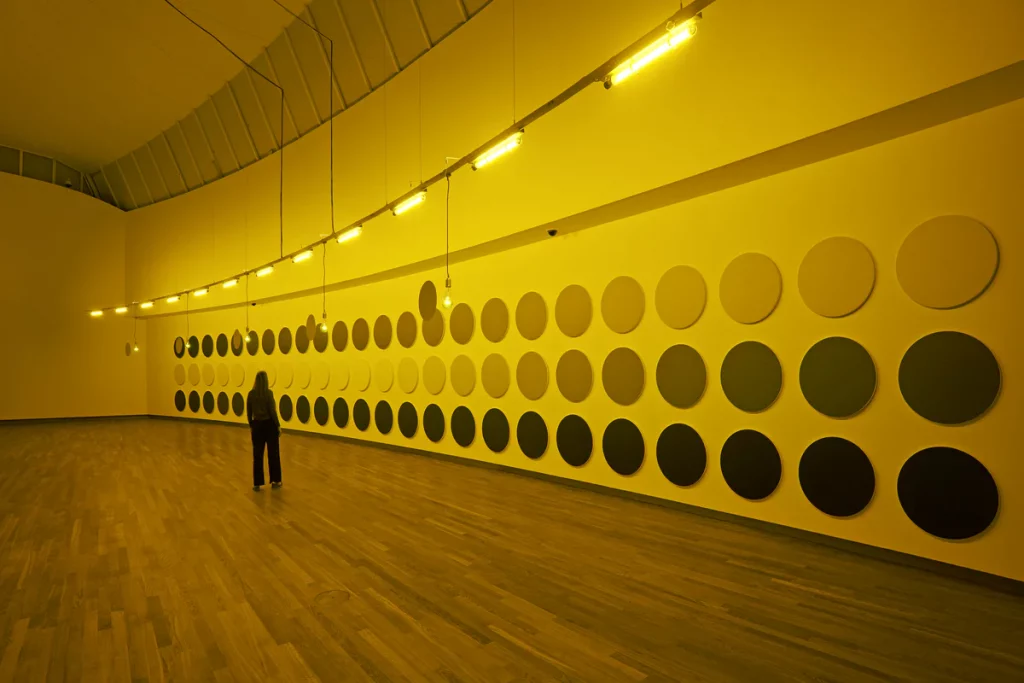
Olafur Eliasson, installation presented as part of the exhibition “Yellow. Beyond Van Gogh’s Colour” at the Van Gogh Museum. Photo © Michael Floor
('Tout le monde le sait, le jaune, l’orangé et le rouge inspirent et représentent des idées de richesse, de gloire et d’amour.') Baudelaire, 'L’Art romantique', Paris, 1885, p. 11. Reprinted in Œuvres de la Pléiade, 1954, p. 859.
The Van Gogh Museum exhibition, the first of its kind to explore the role of yellow in Van Gogh’s work and that of his contemporaries, brings together artists such as Marc Chagall, William Turner, Wassily Kandinsky, and Hilma af Klint. It explores the many connotations of this color—warmth, courage, renewal—through art, fashion, literature, and music around 1900. It is within this chromatic and historical dialogue that 'L'Enfant couronné' finds its rightful place.
Aristide Maillol, 'L'Enfant couronné', 1892, Oil on canvas, 47 x 40.5 cm Lent by the Galerie Dina Vierny, Aristide Maillol’s 'L’Enfant couronné' is on view in the exhibition “Yellow. Beyond Van Gogh’s Colour” at the Van Gogh Museum in Amsterdam, running through May 17, 2026. This loan contributes to the international recognition of Maillol’s work, which the gallery has consistently championed.
Painted in 1892, this oil on canvas isolates the solemn profile of a young girl crowned with flowers against a bright yellow background, rendered in fragmented brushstrokes and dotted with white daisies. This yellow is not one of brilliance or provocation—it is an inner light, serene, almost vegetal, that envelops the figure of the child with closed eyes and lends her an almost sacred dimension. It creates an atmosphere of mystical serenity, reinforced by the stylization of the foliage and the flat background—a deliberate dialogue with the ideas of Gauguin. This painting attests to Maillol’s particularly keen sensitivity to the hidden values of childhood—its purity, its innocence, the silent gravity of the transition to adolescence. The gesture of the wreath of flowers, suspended in time, elevates the scene beyond the anecdotal to make it an image laden with meaning: that of a threshold, a promise, a rite. A few years later, Maillol would continue this same celebration of youth in his sculpture, through magnificently full feminine forms brimming with promise.
('Tout le monde le sait, le jaune, l’orangé et le rouge inspirent et représentent des idées de richesse, de gloire et d’amour.') Baudelaire, 'L’Art romantique', Paris, 1885, p. 11. Reprinted in Œuvres de la Pléiade, 1954, p. 859.
The Van Gogh Museum exhibition, the first of its kind to explore the role of yellow in Van Gogh’s work and that of his contemporaries, brings together artists such as Marc Chagall, William Turner, Wassily Kandinsky, and Hilma af Klint. It explores the many connotations of this color—warmth, courage, renewal—through art, fashion, literature, and music around 1900. It is within this chromatic and historical dialogue that 'L'Enfant couronné' finds its rightful place.

Olafur Eliasson, installation presented as part of the exhibition “Yellow. Beyond Van Gogh’s Colour” at the Van Gogh Museum. Photo © Michael Floor
Galerie Dina Vierny
36 rue Jacob 75006 Paris
53 Rue de Seine, 75006 Paris
Open from Tuesday to Saturday from 11 a.m. to 7 p.m.
Galerie Dina Vierny
36 rue Jacob 75006 Paris
53 Rue de Seine, 75006 Paris
Open from Tuesday to Saturday from 11 a.m. to 7 p.m.