
In 1948, Robert Couturier participated for the very first time in the Venice Biennale, one of the most foundational international events for contemporary art in post-war Europe.16.05.2026
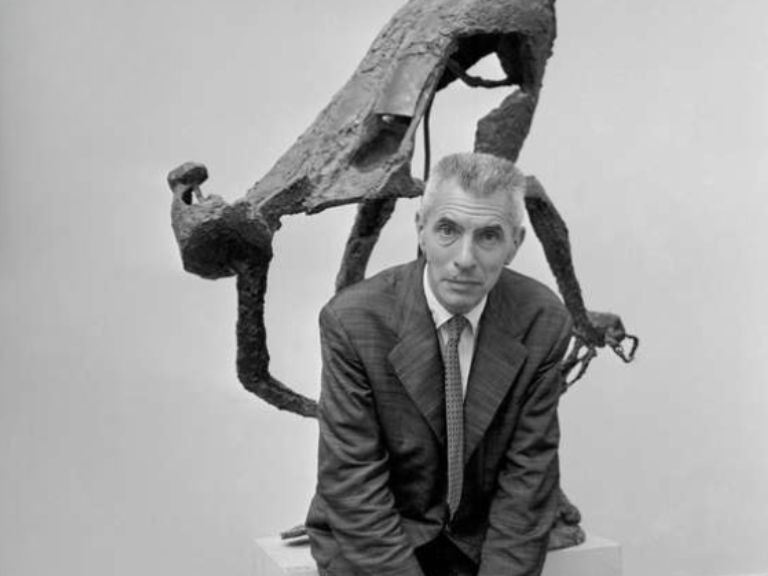
Robert Couturier, in front of Femme s’essuyant la jambe, 1952, at the 1960 Biennale di Venezia © Farabola / Bridgeman Images The selection of artists was made at the national level by independent committees. Robert Couturier was selected on three occasions: in 1948, 1950, and 1960—three distinct participations that attest both to the evolution of his artistic practice and to the artist's growing importance on the French sculptural scene. At each edition, he was chosen to be the ambassador of French sculpture, and more precisely to represent the new figurative sculpture. For his first participation in this major event, Robert Couturier presented Sophie, a plaster sculpture created ten years earlier. The post-war period proved difficult for the artist, who suffered from a lack of recognition. At that time, emerging sculptors were often positioned in continuity with the great masters of the interwar period, which allowed them to assert their legitimacy in the eyes of a relatively hostile contemporary public. Sophie was thus presented alongside one of his master Maillol's most famous sculptures, La Nuit, with which it entered into dialogue.
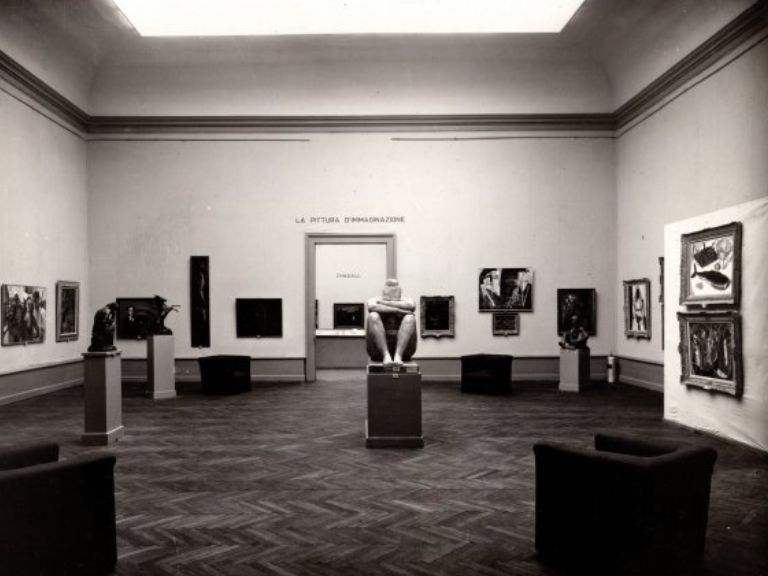

View of the French Pavilion at the 1948 Biennale di Venezia © DR
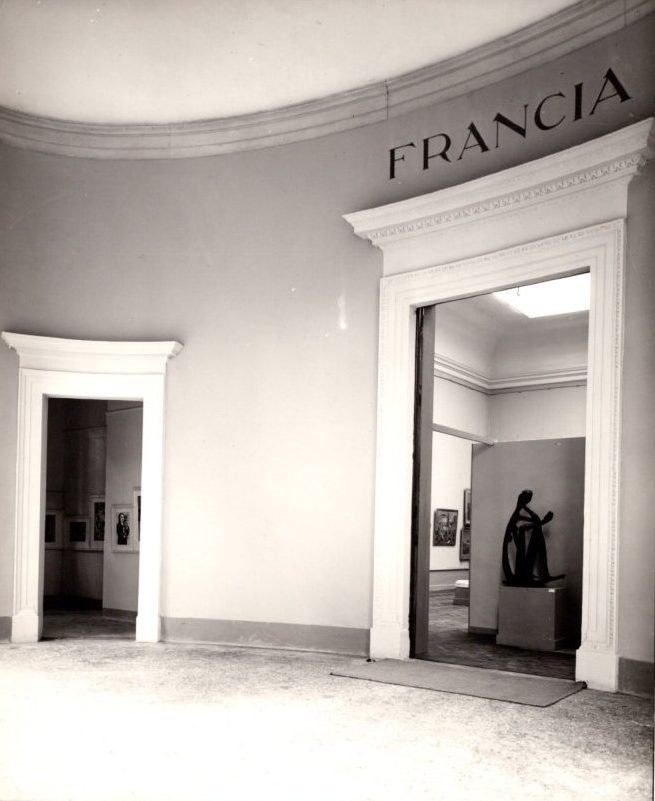
1950: An Assertive Voice Emerges At the 1950 Biennale, a noticeably more assertive Robert Couturier was discovered, presenting works more representative of his own style, as he gradually moved away from the Maillolian aesthetic. He exhibited La Jeune fille Lamelliforme—one of his masterpieces, which he would also present at the São Paulo Biennale in 1951—as well as a plaster model of the Monument à Étienne Dolet, Adam et Eve, Saint Sébastien, La Faune, and Nocturne. A common denominator united these works: the exploration of elongated masses and reduced volumes. Within the French Pavilion, they were placed in dialogue with Henri Matisse's Serpentine (1909), thus establishing a new formal filiation between the undisputed master and the young Couturier.

View of the French Pavilion at the 1950 Biennale di Venezia © DR
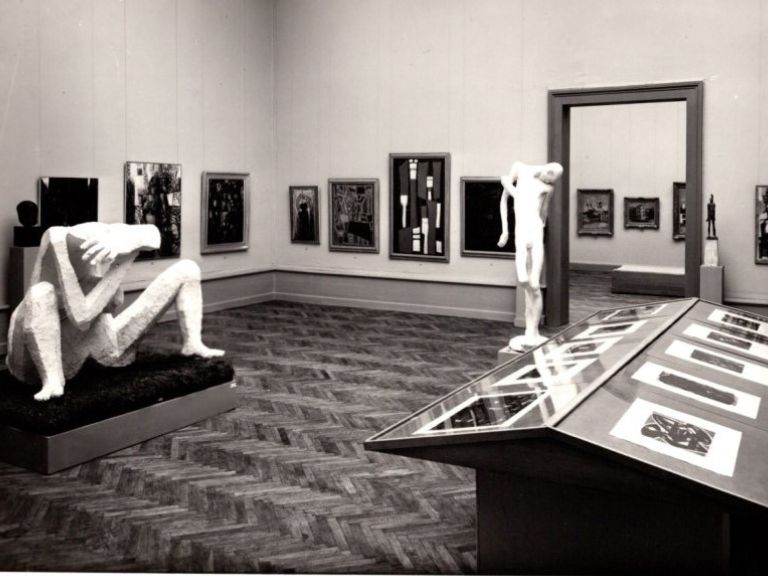
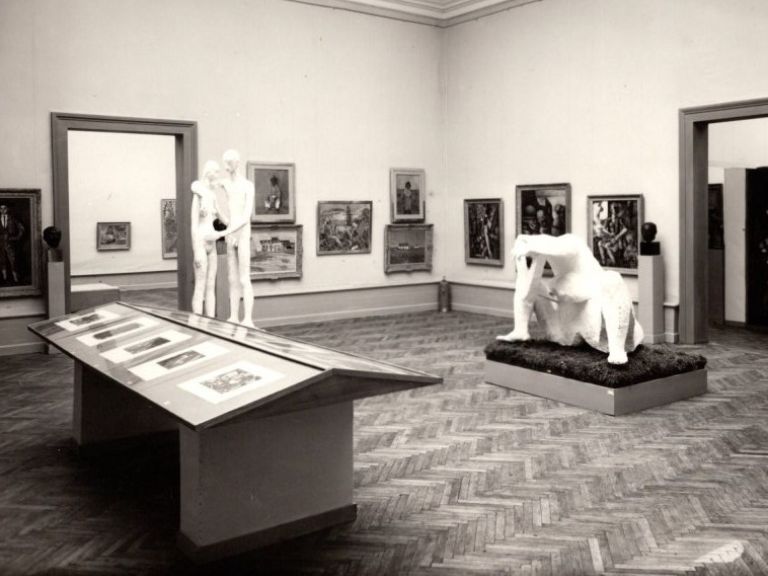
1960: Consecration amid Controversy At the 1960 edition, Couturier presented a group of works more fully representative of his sculptural research: Femme qui marche, Le Berger, La Pensée, Femme debout à la cruche, among others. He also exhibited four drawings echoing his sculptures—Léda, Satyre, Plage, and Mer. The submissions for this edition were managed through the critic Raymond Cogniat, who secured the central room of the French Pavilion to be entirely devoted to Robert Couturier. Cogniat also proposed installing one or two pieces in the garden, outside the pavilion—a decision that extended his reflection on the relationship between sculpture and architectural space. This participation sparked contrasting critical reactions. Pierre Restany, in the journal Cimaise, wrote with biting irony that France had placed "in the place of honor Robert Couturier, his Idylle, his Danaïde and his swimmers," while acknowledging the artist's "considerable plastic sense," before concluding that "the School of Paris offered more interesting possibilities of choice to our selectors." This ambivalent reception reflects the profound tensions that were running through the artistic scene at the time: contemporary sculpture was struggling to gain acceptance for its new plastic approaches, especially those championed by young figurative sculptors. Contrary to this interpretation, Raymond Cogniat, in his essay for the catalogue, painted an entirely different portrait of the artist. He presented him as an independent sculptor, "marked by no precise influence," in the distant continuity of Maillol, while emphasizing that his work "unquestionably inscribes itself in current aesthetics and in the most personal manner." For Cogniat, Couturier belonged to the present through "this need for invention in the writing that completely renews appearances." He perceived in it a natural grace that related him to the sculptors of the gardens of Versailles, coupled with a tension and anxiety that anchored him in contemporary drama. "They are as alive as a newly formed thought," he wrote about his figures, reaffirming that in his most original inventions, Couturier "always gives the impression of respecting the truth."

View of the French Pavilion at the 1950 Biennale di Venezia © DR

View of the French Pavilion at the 1950 Biennale di Venezia © DR
These three exhibitions in Venice, from 1948 to 1960, trace the trajectory of a sculptor who, having started out in Maillol’s shadow, gradually established a unique artistic language rooted in figuration without ever being confined by it. The mixed reception of 1960, caught between Restany’s severity and Cogniat’s commitment, reflects less a judgment on Couturier than the deep tensions of an art scene then torn between renewed figuration and triumphant avant-gardes.
1950: An Assertive Voice Emerges At the 1950 Biennale, a noticeably more assertive Robert Couturier was discovered, presenting works more representative of his own style, as he gradually moved away from the Maillolian aesthetic. He exhibited La Jeune fille Lamelliforme—one of his masterpieces, which he would also present at the São Paulo Biennale in 1951—as well as a plaster model of the Monument à Étienne Dolet, Adam et Eve, Saint Sébastien, La Faune, and Nocturne. A common denominator united these works: the exploration of elongated masses and reduced volumes. Within the French Pavilion, they were placed in dialogue with Henri Matisse's Serpentine (1909), thus establishing a new formal filiation between the undisputed master and the young Couturier.
Robert Couturier, in front of Femme s’essuyant la jambe, 1952, at the 1960 Biennale di Venezia © Farabola / Bridgeman Images In 1948, Robert Couturier participated for the very first time in the Venice Biennale, one of the most foundational international events for contemporary art in post-war Europe.
The selection of artists was made at the national level by independent committees. Robert Couturier was selected on three occasions: in 1948, 1950, and 1960—three distinct participations that attest both to the evolution of his artistic practice and to the artist's growing importance on the French sculptural scene. At each edition, he was chosen to be the ambassador of French sculpture, and more precisely to represent the new figurative sculpture. For his first participation in this major event, Robert Couturier presented Sophie, a plaster sculpture created ten years earlier. The post-war period proved difficult for the artist, who suffered from a lack of recognition. At that time, emerging sculptors were often positioned in continuity with the great masters of the interwar period, which allowed them to assert their legitimacy in the eyes of a relatively hostile contemporary public. Sophie was thus presented alongside one of his master Maillol's most famous sculptures, La Nuit, with which it entered into dialogue.
1950: An Assertive Voice Emerges At the 1950 Biennale, a noticeably more assertive Robert Couturier was discovered, presenting works more representative of his own style, as he gradually moved away from the Maillolian aesthetic. He exhibited La Jeune fille Lamelliforme—one of his masterpieces, which he would also present at the São Paulo Biennale in 1951—as well as a plaster model of the Monument à Étienne Dolet, Adam et Eve, Saint Sébastien, La Faune, and Nocturne. A common denominator united these works: the exploration of elongated masses and reduced volumes. Within the French Pavilion, they were placed in dialogue with Henri Matisse's Serpentine (1909), thus establishing a new formal filiation between the undisputed master and the young Couturier.

View of the French Pavilion at the 1950 Biennale di Venezia © DR
1960: Consecration amid Controversy At the 1960 edition, Couturier presented a group of works more fully representative of his sculptural research: Femme qui marche, Le Berger, La Pensée, Femme debout à la cruche, among others. He also exhibited four drawings echoing his sculptures—Léda, Satyre, Plage, and Mer. The submissions for this edition were managed through the critic Raymond Cogniat, who secured the central room of the French Pavilion to be entirely devoted to Robert Couturier. Cogniat also proposed installing one or two pieces in the garden, outside the pavilion—a decision that extended his reflection on the relationship between sculpture and architectural space. This participation sparked contrasting critical reactions. Pierre Restany, in the journal Cimaise, wrote with biting irony that France had placed "in the place of honor Robert Couturier, his Idylle, his Danaïde and his swimmers," while acknowledging the artist's "considerable plastic sense," before concluding that "the School of Paris offered more interesting possibilities of choice to our selectors." This ambivalent reception reflects the profound tensions that were running through the artistic scene at the time: contemporary sculpture was struggling to gain acceptance for its new plastic approaches, especially those championed by young figurative sculptors. Contrary to this interpretation, Raymond Cogniat, in his essay for the catalogue, painted an entirely different portrait of the artist. He presented him as an independent sculptor, "marked by no precise influence," in the distant continuity of Maillol, while emphasizing that his work "unquestionably inscribes itself in current aesthetics and in the most personal manner." For Cogniat, Couturier belonged to the present through "this need for invention in the writing that completely renews appearances." He perceived in it a natural grace that related him to the sculptors of the gardens of Versailles, coupled with a tension and anxiety that anchored him in contemporary drama. "They are as alive as a newly formed thought," he wrote about his figures, reaffirming that in his most original inventions, Couturier "always gives the impression of respecting the truth."

View of the French Pavilion at the 1950 Biennale di Venezia © DR

View of the French Pavilion at the 1950 Biennale di Venezia © DR
These three exhibitions in Venice, from 1948 to 1960, trace the trajectory of a sculptor who, having started out in Maillol’s shadow, gradually established a unique artistic language rooted in figuration without ever being confined by it. The mixed reception of 1960, caught between Restany’s severity and Cogniat’s commitment, reflects less a judgment on Couturier than the deep tensions of an art scene then torn between renewed figuration and triumphant avant-gardes. Galerie Dina Vierny
36 rue Jacob 75006 Paris
53 Rue de Seine, 75006 Paris
Open from Tuesday to Saturday from 11 a.m. to 7 p.m.
Galerie Dina Vierny
36 rue Jacob 75006 Paris
53 Rue de Seine, 75006 Paris
Open from Tuesday to Saturday from 11 a.m. to 7 p.m.